

Ploegsteert Memorial

The Ploegsteert Memorial to the Missing is a Commonwealth War Graves Commission memorial in Belgium which commemorates more than 11,000 British and Empire troops who fell on the northern Western Front outside the Ypres Salient and have no known grave.

The memorial is located around 13 kilometres south of Ypres, in the village of Ploegsteert. It stands opposite Hyde Park Corner (Royal Berks) Cemetery, and in the middle of Berks Cemetery Extension. These two adjacent cemeteries, named after the London landmark and the Royal Berkshire Regiment, which first used them, contain between them 963 burials from the fighting of the Ypres Salient, of which 548 are British, 150 Canadian, 181 Australian, 80 New Zealand, and 4 German.
Just after the start of the First World War, the nearby Ploegsteert Wood had been the site of fierce fighting. Afterwards, however, it became a relatively quiet sector with no major action. Allied units were sent here to recuperate and retrain after fighting elsewhere and before returning to active operations. The municipality of Comines-Warneton, at the southern hinge of the Ypres Salient, was cut in two, with the Allies occupying the Ploegsteert sector, and the Germans holding Warneton and Comines. Under constant artillery bombardment by both sides, this 12-kilometre front varied little until the onset of the Third Battle of Ypres in the Summer of 1917.
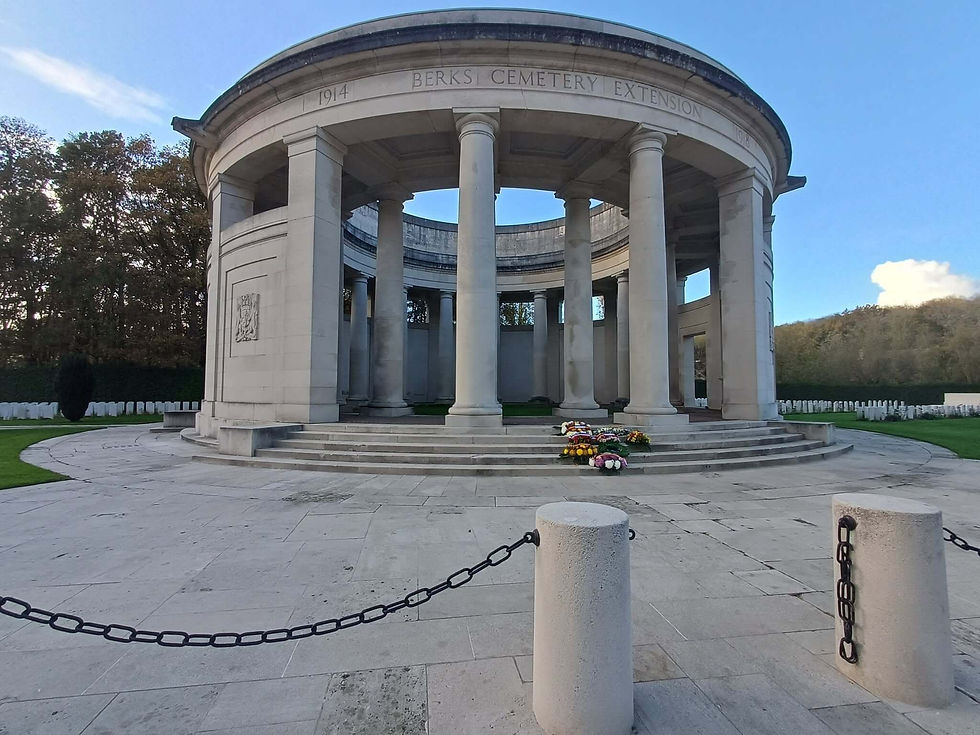
Thousands of British soldiers and a few Germans are buried in the region’s 20 war cemeteries. Commonwealth troops founded Berks Cemetery Extension in June 1916 as an extension to Hyde Park Corner (Royal Berks) Cemetery, which lies across the road. The cemetery grounds were assigned to the United Kingdom in perpetuity by King Albert I of Belgium in recognition of the sacrifices made by the British Empire in the defence and liberation of Belgium during the war.

Later, the Ploegsteert Memorial to the Missing was built as one of several CWGC Memorials to the Missing along the Western Front. It commemorates more than 11,000 servicemen of the United Kingdom and South African forces who died in this sector and have no known grave. The memorial serves the area from the line Caestre-Dranoutre-Warneton in Belgium to the north, to Haverskerque-Estaires-Fournes in France to the south, including the towns of Hazebrouck, Merville, Bailleul, and Armentieres, the Forest of Nieppe, and Ploegsteert Wood.

Most of those commemorated on the memorial did not die in major offensives, such as those which took place around Ypres to the north, or Loos to the south. Most were killed in the course of the day-to-day trench warfare which characterised this part of the line, or in small-scale set engagements, usually carried out in support of the major attacks taking place elsewhere.

The memorial does not include the names of the missing from Canadian or Indian regiments. They are instead commemorated at the Menin Gate Memorial, at the Canadian National Vimy Memorial, or the Neuve-Chapelle Indian Memorial. Similarly, the missing of New Zealand and Newfoundland are honoured on separate, dedicated national monuments. Soldiers lost in the "Southern Pincer" of the Battle of Aubers Ridge are named on the Le Touret Memorial, and those who went missing in the main Ypres Salient are commemorated at the Menin Gate or Tyne Cot Memorial.

The Ploegsteert Memorial consists of a circular shrine with an open rotunda, supported by pillars, with exterior panels inscribed with the names of the missing. Two large and resplendent stone lions flank the memorial. The memorial was designed by Harold Chalton Bradshaw, apart from the two lions, which were commissioned from the sculptor Gilbert Ledward. It was unveiled on 7th June 1931 by the then-Duke of Brabant, later King Leopold III of Belgium. Since 7th June 1999, the Comité du Memorial de Ploegsteert has arranged for the Last Post to be played at the Ploegsteert Memorial on the first Friday of each month, at 7 pm.


Comments