

Ulster Memorial Tower

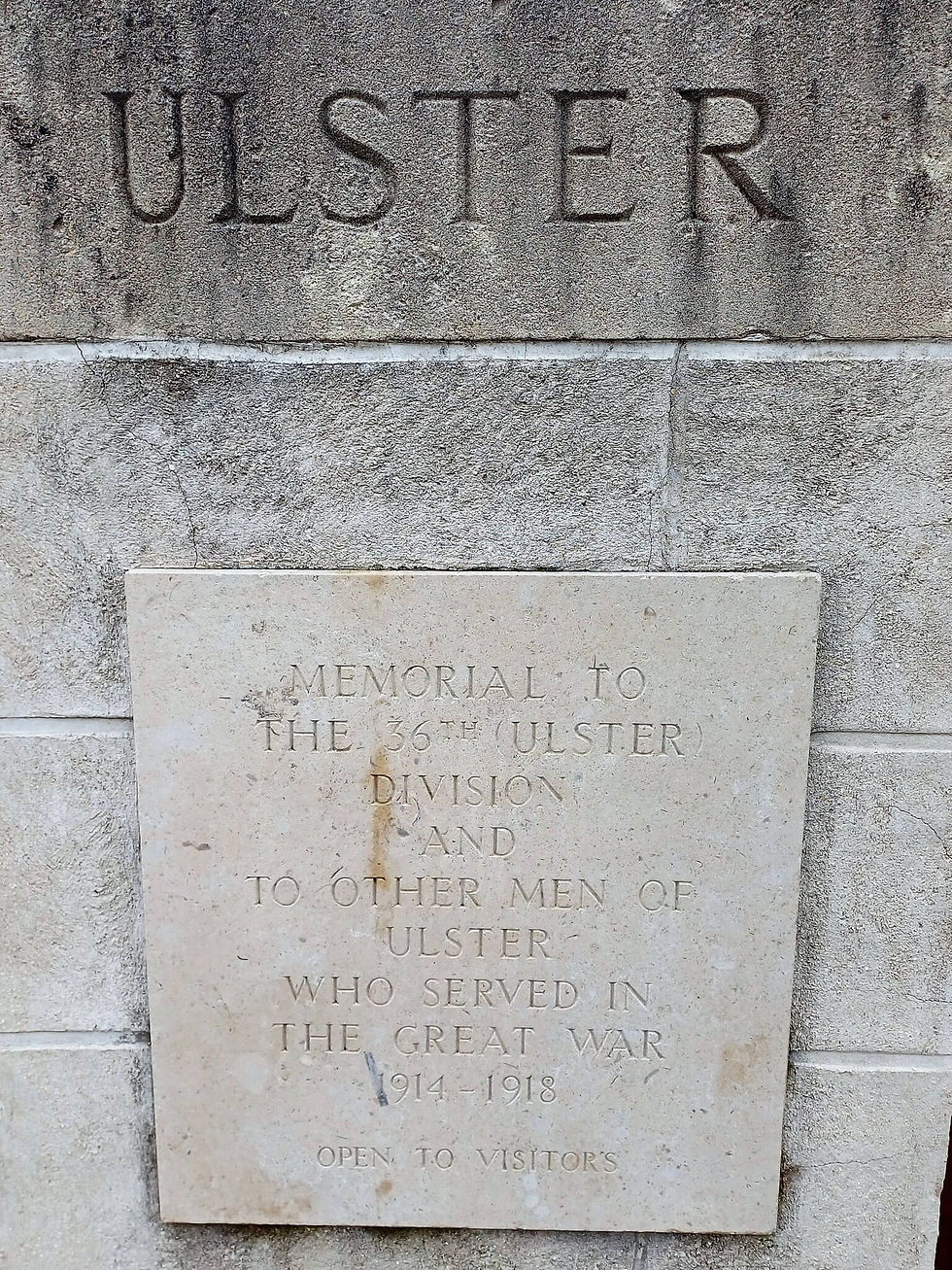
The Ulster Memorial Tower, located about one kilometre northwest of Thiepval, in the Somme department of France, is Northern Ireland's National War Memorial. It commemorates all Ulstermen who served in the First World War, and in particular, the officers and men of the 36th (Ulster) Division, with the memorial’s location serving as a permanent reminder of that unit’s heroic exploits on the opening day of the Battle of the Somme.

The memorial faces Thiepval Wood, from where the men of the 36th (Ulster) Division launched their assault at 7.30 am on 1st July 1916. They were to attack a position known as the Schwaben Redoubt, a formidable German strongpoint consisting of machine gun emplacements, trenches, and dugouts. The Ulstermen advanced across no man's land, storming the German trenches with remarkable speed and dash, overrunning the first line and capturing the Schwaben Redoubt. In some places, they got as far as the German second line.

Although the division held out for most of the day, failure to advance by other units on their flanks left the Ulstermen in a precarious position, exposed to heavy fire and German counterattacks. With casualties rising and ammunition running low, as well as the fear that the division could become cut off, the order was given to withdraw. The Ulstermen suffered devastating losses, with over 5,000 casualties, including 2,069 fatalities, a testament to their bravery but also to the brutal reality of the battle.
In late 1919, a year after the war ended, at a meeting at the Old Town Hall in Belfast, the decision was taken to build a monument on the Somme, on the site where so many men of the 36th (Ulster) Division had fallen. Construction began soon after by Fenning & Co. Ltd. of Hammersmith, London, on land purchased from three separate families. The Ulster Memorial Tower was the first official memorial to be erected on the Western Front.
Designed by architects Albert Leigh Abbott and James Albert Bowden, the tower is a replica of a well-known Ulster landmark, Helen’s Tower, located in County Down, Northern Ireland. It was in the shadow of this tower that the men of the then newly formed 36th (Ulster) Division had received their training following the outbreak of war. For many Ulstermen, it would have been one of their last memories of home before they departed for England and subsequently the Western Front.

The memorial was unveiled on 19th November 1921 by Field Marshal Sir Henry Wilson, a famous Irish soldier who was then the Chief of the Imperial General Staff of the British Army. The tower was dedicated by the Primate of All Ireland, the Moderator of the Presbyterian Church in Ireland, and the President of the Methodist Church in Ireland. Trees from Ulster were planted by surviving veterans from the 36th (Ulster) Division.
Standing at around 21 metres, the Ulster Memorial Tower is one of the most imposing memorials on the Western Front. At its entrance is a memorial plaque commemorating the nine men of the 36th (Ulster) Division who were awarded the Victoria Cross during the war. Three of these medals were won on 1st July 1916, and one on the following day. Inside the tower is a small chapel with several paintings and a large collection of plaques from various regiments, local authorities, and organisations, as well as a Book of Remembrance. Behind the tower and to its right is a small garden with a memorial commemorating the part played by members of the Orange Order during the Battle of the Somme.
Up until the early 1970s, the tower had a resident caretaker and served as a focus for pilgrimages to the Somme battlefields. By the late 1980s, however, the structure had fallen into disrepair. A cross-community group known as the Farset Somme Project began lobbying for its refurbishment, and it was rededicated by HRH Princess Alice, Duchess of Gloucester, on 1st July 1989. It has since been reopened for visitors under the management of the Somme Association, whose task is to research, commemorate, and educate the public about Ireland's involvement in World War I, and to make sure that the sacrifices of all those who served continue to be honoured and remembered.


Comments